

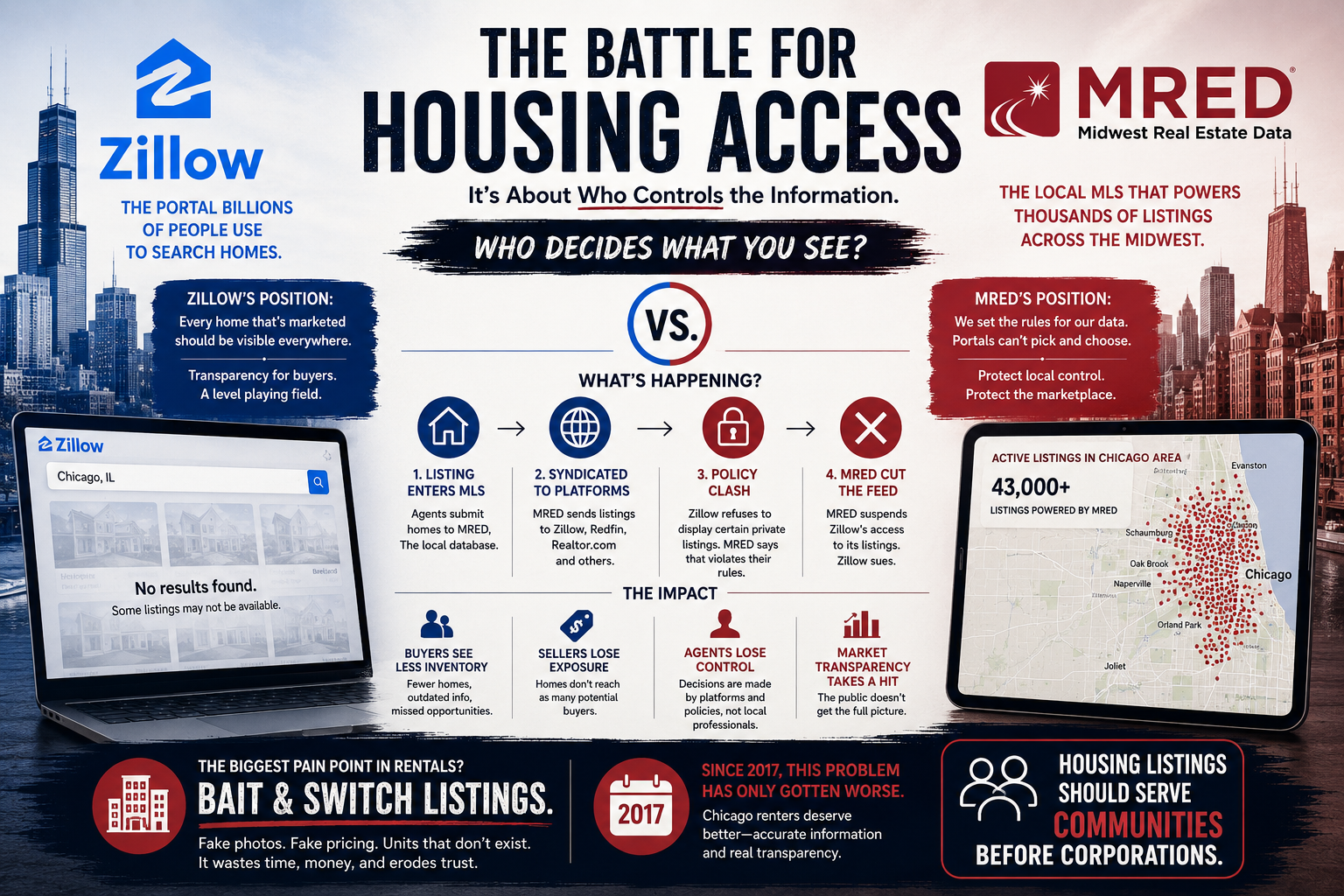
If you’re not in real estate, the recent conflict between Zillow, MRED, Compass, and even Google probably sounds like inside-industry drama. But what’s happening right now is one of the most important shifts in housing search we’ve seen in years — and it may fundamentally change how homes and rentals are communicated to the public moving forward.
This isn’t just about one lawsuit.
It’s about who controls housing inventory, who controls consumer attention, and ultimately who controls access to housing information itself. And for those of us who have worked in housing for a long time, especially rentals, this moment feels bigger than a simple dispute between corporations.
It feels like the beginning of a structural shift.
What Is Actually Happening?
Most consumers think websites like Zillow create listings.
In reality, platforms like Zillow largely receive listing data from MLS systems — regional databases where agents and brokerages upload homes for sale.
In the Chicago area, that system is MRED (Midwest Real Estate Data).
MRED powers listing distribution across a huge portion of the Midwest, syndicating listings to sites like:
- Zillow
- Redfin
- Realtor.com
- brokerage websites
- and countless other real estate platforms
For years, this relationship functioned quietly in the background. But recently, tensions between MLS systems, brokerages, and portals have escalated dramatically.
At the center of the conflict is something called private listings or private exclusives.
Traditionally, a home would:
- Go into the MLS
- Become publicly searchable everywhere
Now, some brokerages — particularly Compass — have pushed harder into private inventory strategies where listings may first be marketed internally, privately, or within select networks before hitting public platforms. Zillow responded by introducing a policy stating that if a listing is publicly marketed anywhere, it must also appear publicly on Zillow within one day or Zillow may refuse to display it altogether. MRED argued that Zillow was attempting to impose its own rules onto listings that were otherwise lawful and compliant under MLS policy.
The disagreement escalated quickly.
Zillow filed a federal antitrust lawsuit against MRED and Compass, accusing them of colluding to limit competition and manipulating inventory access.
MRED then suspended Zillow’s direct access to its listing feed.
Almost overnight, thousands of Chicago-area listings disappeared from Zillow.
At the same time, new developments like eXp’s partnership with Google suggest the industry may be moving toward entirely new models of listing discovery outside of the traditional portal ecosystem. For consumers, this may look chaotic. But underneath it is a much deeper question:
Who should control housing visibility in the digital age?
The Housing Industry Is Entering A Power Realignment
For the last decade, national portals became the dominant “front door” of housing search.
Consumers stopped searching for agents first.
They stopped searching brokerage websites first.
They searched Zillow first.
The platforms became the interface consumers trusted most, even though they did not own the original data itself.
Over time, listings evolved from simple housing information into something much more valuable:
- advertising inventory
- lead generation assets
- traffic engines
- consumer acquisition tools
- behavioral data streams
Whoever controlled visibility controlled the consumer relationship.
And whoever controlled the consumer relationship controlled enormous amounts of money.
Now we’re watching multiple sides attempt to reclaim leverage simultaneously:
- MLSs want to reassert authority over listing distribution
- brokerages want greater ownership of inventory and client relationships
- portals want to maintain dominance over consumer search behavior
- and tech companies like Google are increasingly positioning themselves as the next discovery layer
The old system is beginning to fracture.
And honestly, that may not entirely be a bad thing.
The Bigger Problem Nobody Talks About Enough: Rentals
While most headlines are focused on home sales, private exclusives, and brokerage disputes, the rental side of housing has quietly suffered from these problems for years — often in much worse ways.
I’ve worked in Chicago rentals for over 12 years, and the single biggest complaint we’ve consistently heard from renters is simple:
Bait-and-switch listings.
Fake availability.
Old inventory.
Misleading pricing.
Duplicate listings.
Stock photography.
Units that never existed in the first place.
Listings used primarily to generate leads rather than help people find housing.
For renters, this creates a deeply frustrating and exhausting experience.
Apartment searching already comes with enough stress:
- financial pressure
- moving timelines
- application costs
- neighborhood uncertainty
- rising rents
- competition for inventory
Adding misinformation into that process erodes trust in the entire housing ecosystem.
When we started our business in 2017, one of the problems we specifically wanted to avoid contributing to was this growing disconnect between what people were seeing online and what actually existed in the market.
At the time, bait-and-switch practices were already common.
But over the years, the problem has only intensified as listing platforms became increasingly optimized around traffic, lead generation, and visibility metrics.
And that’s what makes this current moment so interesting.
Because the MRED/Zillow conflict is exposing something many consumers have already felt for a long time:
The current housing search ecosystem is not always designed around trust.
Housing Information Has Become Financialized
What we are seeing now is not just a technology battle.
It’s the financialization of housing information itself.
Listings are no longer just listings.
They are:
- leverage
- market share
- data ownership
- advertising opportunities
- and strategic inventory control
The platforms argue they are protecting transparency.
Brokerages argue they are protecting seller choice.
MLSs argue they are protecting marketplace fairness.
And all of those arguments contain some truth.
But somewhere in the middle, consumers are left trying to navigate increasingly fragmented systems while simply searching for a place to live.
That is why this moment matters beyond real estate professionals.
Because access to accurate housing information affects:
- affordability
- mobility
- neighborhood access
- economic opportunity
- and quality of life
Housing search is not just another internet category.
It functions more like infrastructure.
Maybe The Future Of Housing Search Needs To Become More Local Again
One of the most interesting things this conflict may reveal is the limitation of centralized housing platforms altogether.
Housing is fundamentally local.
Chicago housing operates differently than Miami.
Logan Square functions differently than River North.
Renters face different challenges than luxury home sellers.
Neighborhood dynamics matter.
Local knowledge matters.
Community trust matters.
Yet for years, housing search became increasingly centralized through massive national platforms whose incentives are often tied to engagement, advertising, and scale.
Maybe the next phase of housing technology moves in a different direction.
More:
- locally focused
- verification-driven
- community accountable
- transparent
- and trust-centered
Not necessarily anti-technology.
Not anti-MLS.
Not anti-agent.
Not anti-platform.
But perhaps less dependent on giant corporate listing ecosystems controlling the majority of housing visibility.
Because when a handful of corporations control how housing information is distributed, ranked, filtered, or monetized, communities inevitably lose some control over their own housing ecosystems.
This May Be The Beginning Of A Much Larger Shift Between:
- changing commission structures
- private listing expansion
- AI-powered search
- Google entering discovery
- MLS pushback
- and growing consumer distrust of listing accuracy
The housing industry may be entering its biggest communication shift since online search platforms first emerged. The next generation of housing platforms may look very different from the last. And hopefully, they become more accountable to the communities they serve. Because housing is too important to function solely as a traffic engine.
At its core, housing is about people, neighborhoods, stability, and access.
And perhaps this moment forces the industry to reconsider a simple but important idea:
Housing listings should serve communities before corporations.
Check out this article next